Kids Masquerade Masks: Sizing and Safety for Young Guests
Kids Masquerade Masks Explained
A kids masquerade mask is exactly what it sounds like, a scaled-down version of the classic Venetian or filigree mask, cut smaller across the face and usually fitted with softer, more forgiving elastic. It matters more than people expect. An adult mask perched on a nine-year-old doesn’t just look wrong in photos, it slides down the nose within twenty minutes, gets pushed up onto the forehead, or ends up dangling around the neck for the rest of the party. We see this constantly when parents grab a standard mask off the shelf thinking “kids are just smaller adults” and the mask simply isn’t built for a smaller skull, narrower cheekbones or a shorter bridge of the nose.
Masquerade parties for kids have become a genuine trend here in Australia, whether it’s a themed school formal, a birthday party with a Venetian Carnival brief, or a family masquerade night where everyone from grandparents to toddlers gets a mask. The mask is often the whole costume. Nobody wants to spend forty minutes on a Venetian-style outfit only to have the mask itself be the thing that falls apart in the group photo.
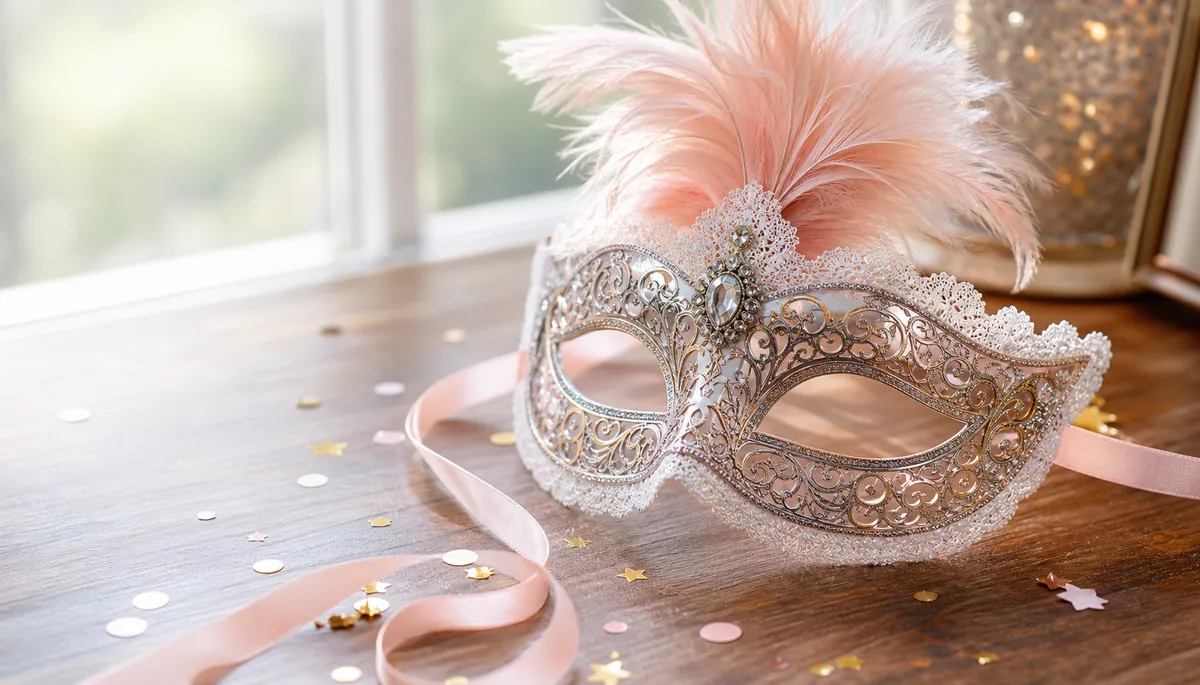
What separates a genuinely good kids mask from a shrunken adult one comes down to three things: face-width measurements, weight of the materials, and how the strap or ribbon sits against a smaller head. Get those right and the mask becomes part of the fun rather than a nuisance the child is fighting with all night.
Choosing the Right Fit and Size
Start with a tape measure, not a guess. Measure across the child’s face from the outer edge of one eye socket to the other, then check the distance from the bridge of the nose to where the mask would sit on the cheekbone. Most kids aged 5 to 9 sit somewhere between 10 and 12 centimetres across the eye zone, while pre-teens (10 to 13) are closer to adult proportions but still benefit from a slightly narrower cut through the temples.
Elastic tension is the detail people skip and regret. Too tight and you’ll get complaints (and headaches) within the hour. Too loose and the mask slides every time the child laughs, dances or turns their head quickly, which, if you know kids, is constantly. We generally recommend an adjustable elastic or ribbon tie over a fixed loop for anyone under 12, simply because it lets you fine-tune the fit on the day rather than committing to a size weeks in advance based on a rough guess.
Ribbon ties do double duty as well. They sit flatter against fine or fly-away hair than thick elastic, and they’re easier to loosen mid-party if a child says the mask feels tight after running around for an hour. If you’re outfitting more than one child, our full range of masquerade masks lets you filter by size and strap style so you’re not eyeballing it from product photos alone.
One more thing worth checking: nose bridge height. Kids’ noses are proportionally flatter than adults’, so a mask designed with a high, sculpted bridge for an adult face will often sit awkwardly or leave gaps at the sides on a child. Lower-profile filigree designs tend to sit closer to the face and look more natural on younger guests.
Top Styles for Young Guests
Not every masquerade style translates well to a child’s face or a child’s patience for fiddly accessories. A few styles consistently work better for the under-14 crowd.
Lightweight filigree masks are the easiest starting point. The open metalwork design means less material sitting against the skin, which matters a lot on a warm evening or at an outdoor event. Our filigree metal masks come in a range of finishes, and the black filigree styles in particular photograph beautifully without being too heavy for smaller faces. If you’re doing a colour-coordinated family masquerade, the blue crystal filigree masks and clear filigree crystal masks are popular for kids who want something sparkly without the full weight of a feathered piece.
Leather masks are the other reliable option, mainly because they’re durable enough to survive being dropped, sat on, or stuffed in a backpack after the party, which is realistically how most kids’ costume accessories end up treated. They also tend to have a lower profile than the more ornate feathered designs. Have a look through the leather masks collection if durability is your main concern, and the black leather masks or blue leather masks both work well as a neutral base that pairs with almost any costume colour.
What we’d steer families away from for younger kids: anything with long trailing feathers near the eyes (they get grabbed, bent, and occasionally end up in someone’s mouth), heavy full-face designs, and masks with small glued-on gems that aren’t rated for children’s products. More on that in the next section.
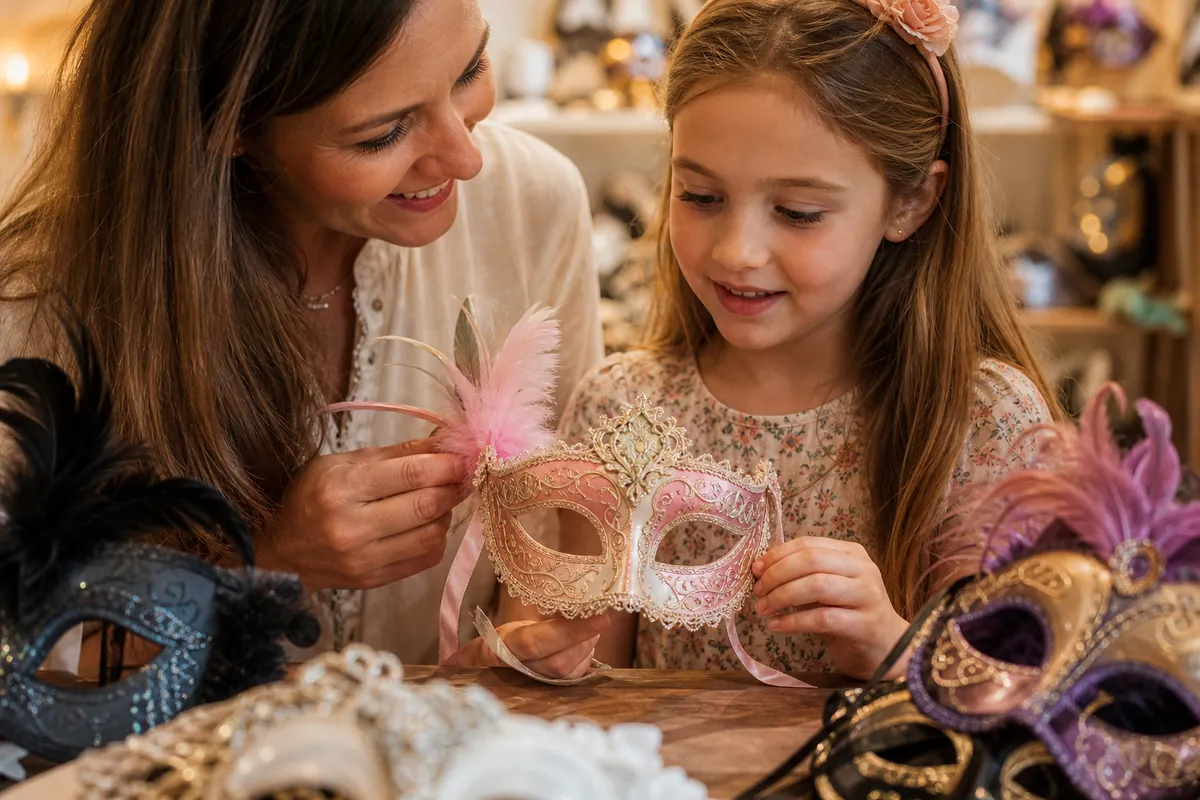
If the budget’s tight or you’re outfitting a whole group of kids for a school event, it’s worth checking our clearance masks before committing to full-price pieces across the board. We rotate stock through there regularly and it’s often where the simpler, sturdier styles end up.
What to Check Before You Buy
Safety is the part that actually matters most here, more than colour matching or theme coordination. A few checks take thirty seconds and save a genuinely bad night.
First, check the eye holes. They need to be large enough that the child’s field of vision isn’t seriously restricted, particularly at events with stairs, dance floors or anywhere they’ll be moving around other people. Peripheral vision gets cut noticeably by narrower Venetian-style eye cuts, which is fine for a still photo but not ideal for a kid running around a backyard for three hours.
Second, check how embellishments are attached. Glued-on crystals, sequins or small beads can work loose over the course of an evening, and for kids under about 6, that’s a legitimate choking hazard worth taking seriously rather than dismissing. Kidsafe Australia’s home and product safety guidance for parents is worth a read if you’re buying for a younger child or a group with a wide age range (Kidsafe Australia). If anything on a mask looks like it could pop off with a bit of tugging, it’s not the right piece for a child under 8.
Third, material weight and breathability. A mask that feels light in your hand for ten seconds in a shop can feel very different after two hours of dancing under lights. Lighter filigree and card-based designs breathe better than heavier resin or full-coverage styles. The Australian Competition and Consumer Commission publishes guidance on choosing and using kids’ toys safely that’s a sensible baseline to check against, particularly around choking hazards and small parts that can work loose (Product Safety Australia).
Fourth, and this one’s easy to forget, check the return policy before the event, not after. Kids’ faces vary a huge amount even within a single age bracket, and what fits one nine-year-old comfortably might be too tight or too loose on another. Browse the full masquerade masks range with sizing notes before you buy in bulk for a party, and if in doubt, order one to trial rather than a full set.
Tips from the Experts
After years of fitting masks for everything from six-year-olds’ birthday parties to teen formals, a few patterns hold up consistently.
Do a trial run at home before the event, ideally the night before, not the morning of. Have the child wear the mask for fifteen or twenty minutes while doing something normal (watching TV, having dinner) rather than just trying it on in front of a mirror for ten seconds. This is the fastest way to catch a pressure point behind the ears or a gap at the temple that won’t show up in a quick fitting.
Colour-match to the outfit, not the other way around. It’s much easier to build a costume around a mask you already love than to hunt for a mask that perfectly matches a costume you’ve already bought. Our cream masks and black masks are the two most versatile neutrals we stock, and they pair with almost any costume colour a child ends up choosing.
For siblings or friend groups attending together, buy from the same colour family rather than identical masks. A group in blue masks with slightly different styles looks far better in photos than five identical pieces, and it avoids the inevitable argument over whose mask is whose by the end of the night.
Finally, involve the child in choosing. A mask picked out by a parent alone, however well-fitted, tends to come off within the first hour if the kid doesn’t actually like how it looks. Fit matters, but so does buy-in. The Royal Children’s Hospital Melbourne publishes a library of Kids Health Info fact sheets for parents that’s worth skimming if you’re outfitting a larger group of kids for a school or community event (Royal Children’s Hospital).
FAQ
What is the best masquerade mask for kids?
Lightweight filigree masks with adjustable ribbon ties tend to work best for most kids, since they’re breathable, sit close to the face, and don’t rely on fixed elastic that can pinch. For durability, a leather mask is a good pick since it survives being dropped or packed away without cracking.
How do I know which kids’ masquerade mask is right for my child?
Measure across the eye zone and check nose bridge height before choosing a style, since kids’ faces are proportionally different to adults’, not just smaller. Then let the child pick the colour and design from within that size range so the mask actually gets worn all night rather than pulled off after ten minutes.
What should I look for when buying a kids’ masquerade mask?
Check the eye holes are wide enough for full peripheral vision, confirm embellishments are securely fixed rather than loosely glued, and go for a lighter material if the event runs several hours. Adjustable straps or ribbon ties are far more forgiving than fixed elastic loops for a growing child.
Are there budget-friendly kids’ masquerade masks?
Yes, our clearance section regularly carries simpler filigree and leather styles at a lower price point, which is a good place to look if you’re outfitting a whole group of kids for a school event or party. Neutral colours like beige and black also tend to be more affordably priced than heavily embellished designs.